Showing posts with label filim. Show all posts
Showing posts with label filim. Show all posts
Saturday, July 30, 2011
Naming Desire
(This week, let the movie themes run amok...)
It was the cliched middle of the night, and I was awakened by a voice. In my groggy, still yet-unwakened state, it was at first a mere outburst of voice. Then, the voice formed a word, a name. "Felicia." "Feli-cia!," all stretched out. "FELI----CIA!!!!" like a modern version of Stanley Kowalski, and his "STELLAAAAAA!" Sound carries far here in the desert, the lower bass end usually disappearing fast. But this fellow had bounced his voice into this narrow canyon of close standing faux-dobe townhouses, with the bass resounding nicely. After a few more Felicias!, he wrapped up his oratory with a surprise, with an "I Love You!" that bounced along the earthen walls, through the wind-catching open windows, and into our imaginations, making us wonder at what it was that had caused Felicia to wander off in a perceived huff. The absence here of hot tin roofs means too the absence of cats. But the dogs chose to have their say, starting up as one. Then it was the baby's turn to critique the performance.
In time, the dogs wrapped it up, as did my girl. But our man Stanley was still out there somewhere, his voice barely audible, being lost to the vastness of landscape, and to the credits now rolling on what had been a brief foray into wakefulness...
On the turntable: Jerry Garcia, "1969-10-28 Fulton Street "


Thursday, July 28, 2011
Moving Pictures
On the way into the theater, I made a quick trip to the bathroom, where I was treated to the sight of a young guy texting with his left hand while he aimed his willie at the porcelain in front of him. The dexterity he displayed was nearly worth the price of admission.
Expecting the Boy Wizard to be cheered on by a large crowd, we'd arrived at the cinema early. This was only the second film I'd seen since coming back to the States last year. Before going to Japan, I used to go to the movies two or three times a week, back in the days when the afternoon show was a buck fifty. These days, I'm more interested in smaller, more talky films, for which a DVD will suffice. Anything worth seeing on the big screen would have to be action-packed, yet these inevitably have a dumb-as-nails, connect-the-dots storyline, which I'd just as soon miss anyway. The Boy Wizard franchise was a nice compromise--good visuals plus intelligent script.
Anyway, in arriving early, I was surprised to see that Enormoplexes these days are now showing previews before the previews. These usually consist of these little "making of" features that serve as low budget advertising. They aren't advertising just films, but television as well, plus a few of the usual auxiliaries which the tendrils of bloated mega-corporations now grope. The weird thing is how little they show of the actual product. The products always look like they're not yet out of the oven. What was even more bizarre is how I at first couldn't tell if what was being presented was parody or not. As we get deeper and deeper into our virtual worlds, the line between reality and parody is getting very very fine. As these ads stalled to something of a conclusion, they were wrapped up by an onscreen announcement that said, "You've just watched, blah blah blah..." I thought, wait a minute, we saw nothing, only saw pieces of this and that, with no substance to speak of. Does this shallowness actually pass for the real nowadays?
The pre-previews then begat actual previews. I usually hate these, the way they bludgeon the adrenals with their ADD editing and soundtrack pumped up to eleven. As they went on (and on and on) I began to get really offended by the quality of what the studios were pushing. Do the suits think we're really that stupid? Or have we actually become that stupid? I was amazed at how many 3D pics are on the way. Gimmicks like 3D, or 25th anniversary big screen re-releases of classics, are always a sign of a film industry in slump. And based on what I'd experienced over the last half hour, film today looks mortally wounded. Ironically, these Buddy Holly glasses we all now wore brought even less clarity, further blurring that line between real and fake.
Then, the curtains rose (metaphorically), the Boy Wizard took the stage, and entering the illusion, I began to hope that he might actually save us.
On the turntable: Ella Fiztgerald and Louie Armstrong, "For Lovers"
On the nighttable: "Larry McMurtry, "The Last Picture Show" (Kinda ironic, ain't it?)
Wednesday, September 22, 2010
Children of Water

Fall in Kyoto has much to offer. Multi-colored maple leaves strewn across stone like little lost gloves. Dango eaten beneath the full autumnal moon. Festive student carnivals played out in game and song.
This fall, there is even more. On October 1st, a band I used to play with, Morphic Jukebox, will play a short set prior to the screening of a film in which I had a hand in, "Children of Water."
It's as if I never left...
Details here at Deep Kyoto.
On the turntable: Neil Young, "Dreamin' Man 92" (I'm here too, in the audience...)
Tuesday, August 17, 2010
Izu Dancing

My work situation has finally stopped thrashing about, entitling me to some free evenings. The nightly monsoons have kept me away from the live music down on The Plaza, so films once again present themselves as alternative. After the marathon stretch of Kobayashi's "The Human Condition" (we could only handle one hour doses of this brutal, 10 hour masterpiece), we've settled in with Shimizu Hiroshi. He reminds us some of our beloved Ozu, manipulating actors as props as a means of diminishing the subjectivity of role, and creating a story that speaks to the universal in us all. If Ozu was a maker of tofu (as he famously claimed), then Shimizu is a master of okayū. He shares Ozu's slow pace of storytelling, yet utilizes camera techniques seemingly cribbed from European Surrealist films of a decade earlier. These effects weren't commonly seen in Hollywood until being 'pioneered' in Citizen Kane in 1941.
Shimizu was one of the first directors to commonly use location rather than sets. To view the dirt roads of 1930's rural Japan is to see the contemporary Laos roads over which I traveled this winter. It also shares a lot with the deep-country Shikoku pilgrimage trails I walked last autumn, minus the power lines and vending machines. Shot on a bus actually traversing the Izu countryside, "ありがとうさん” ("Mr. Thank You") features scenes of a long gone country life rolling on behind the characters, showing it such deference that the landscape itself eventually becomes more important than the actors themselves. It is one of the earliest road movies that I can think of. As I watched it, I surprised myself in that the film reminded me somewhat of John Ford's 'Stagecoach' (filmed three years later), where archetypes are thrown together, then bound by the landscape through which they pass. But rather than solidifying that bond through the drama of an Indian attack, Shimizu's film stays true to the fact that most of our human encounters stay light and impersonal, in our sharing moments with strangers who will remain just that. His films offer glimpses of life that, while possibly thought mundane at the time of release, bask in a beauty that is both bittersweet and enchanting, made more so by their fleeting nature.
On the turntable: Drive-by Truckers, "The Big To-Do"
On the nighttable: Hammett, et al., "The Essence of Santa Fe"
Thursday, June 24, 2010
Rest Your Head for Just Five Minutes...
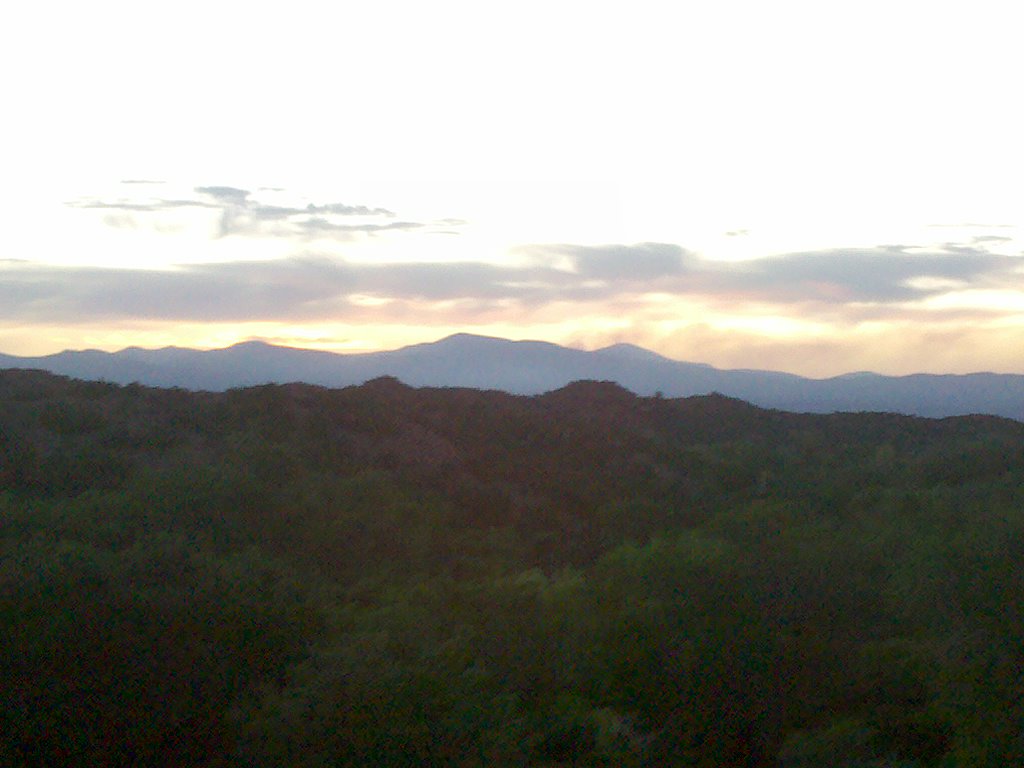
In mid-March, Upaya re-released us into the wild. We settled then, into our new digs in a faux-dobe casita on a hillside just north of town, halfway to Tesuque Pueblo. " Casita" is a Spanish term meaning, "little house," and ours sure fits the bill. A two bedroom, it was open and spacious, but quirky. The shower head came to maybe the level of my chest, the bathtub big and beautiful but the hot water ran out before it could be filled completely. Our joy at our Franklin stove took a header when we found out it was powered by gas. Bizarrely, the stove is electric, and there's no oven at all. Wall and closet space barely exist. Living in Japan is a day to day struggle with compromise, a lifestyle dubbed "creative camping" by one wit. The big house I'd long been envisioning wasn't this. I'd simply moved campsites.
But most of the south wall was all windows, offering major views of the hills and trees beyond. The passive solar worked great, keeping us toasty even through a dozen spring snowstorms. As we moved toward spring, the trees below filled the valley in with color, and as summer comes on, they're exhibiting new fashions yet again. Up on our hilltop, we're surrounded by trees and wildlife. Deer pass by on their daily commute. I'm wary of them at night, as the road out of town allows us to get up to 50mph on the hill. Midway down is a sign warning us of their presence, and one night, a live one stood just below it, watching me pass by. Another night, as I was thinking that a collision with deer is just about the most dangerous animal encounter out here, a bear wandered across the hill above us. Coyotes add an aural presence to the night. My landlady assures me that there are no dangerous snakes at this altitude, but I shuffle my feet when I approach my covered bikes or camp chairs outside. Today I pulled out one of the latter in order to sit with my coffee and watch the thunderheads roll over from the direction of Los Alamos. (The humidity of an encroaching storm is like the hug of grandchild, compared to the anaconda coils of Japan.) I was already moving backside first when I noticed an eight-inch centipede had already commandeered my seat. This bothers me less than the cricket who has been exercising his squatting rights, all night chirp chirp chirping from behind the bricks that support the sink.
It's a pleasure to sit out there on the land, watching the magpies swoop by like a negative image of a Jap Zero, strafing the moles and rabbits hard at work with their landscaping. The sunsets out there at the edge of the hill are magnificent, of the million-dollar variety that this State is renowned for. Clouds, bellylit by the sun, reflect gold over the landscape. Desert grasses glamorize themselves as wheat. That forest fire over in the Jemez has been a recent collaborator, creating a jet trail of black that has evolved into a billowy white plume.
Potlucks are a means of feeding some of us un-moneyed gentry here in town. We had Ouyporn Khuankaew over one night, and on the drive over from Upaya, I pointed out all the multimillion dollar homes in the surrounding hills, most of them empty vacation homes. She was furious, considering how hard she works to get funding for her community. Upaya residents are frequent guests, and it was here that iSaac and I rehearsed for his farewell Zendo gig. With my work schedule Miki and I don't seem to have as many nights alone as we did in Kyoto, so we're watching fewer film. (It's also strange to sit and eat with a film in the weird light of a normal dinner hour and have the credits roll before full dark. Funny how I used to bemoan the short hiking days of a non-daylight savings Japan. Here I turn in about an hour after the sun does.) Nearly all of the films are Japanese classics, as usual, and watching one is like picking at the scab of my homesickness for Japan. Bizarre since New Mexico is my 'actual home.' We'll find a way to reestablish our relationship with Japan; the pre-nup is still a work in progress.
One detriment to living out here is the inevitable return to car culture. We no longer have our short walk to cafes and shopping; nowhere in sight are there any trains or buses. We justified this in a manner of ways: (1) even if we lived in the middle of town, we'd still have to drive in order to visit friends; and (2) this is a good opportunity to try living out in the mountains. This has seen a fundamental change in us. I own my first car at age 42. Miki soloed for the first time about a month ago. Town is a mere half hour away by bike, no different that my old commute, but for the hill and the desert heat. The road isn't that busy, but being desert, people drive too damn fast. There is an element of schadenfreude in the fact that my body and my bike would do about the same amount of damage to a speeding vehicle as a deer.
The night we moved in, we met up with the Upaya gang down the road at Tesuque Market, with its ambiance of an old stage stop and with its miraculous wood-fire pizzas. An hour or so before we'd been cursing the snow, as we lugged nearly 200 boxes (most of them filled with books) up the 39 railroad ties that are a sly wink at Hitchcock. Now, after dark had fallen, the snow-laden trees above truly were that cliched cathedral, emblazoned with white as we made our way toward the beer that is inevitable at the end of a hard day's move.
On the turntable: "Egyptian Noir Nubian Soundtrack"
On the nighttable: Michael Chabon, "The Yiddish Policeman's Union"
Thursday, May 6, 2010
Where Have I Found Beauty
Where have I found beauty? Most of my life it's been in sound, in music, be it the intricate interplay of instrumentation, or in a single soulful voice. In the sounds of the wild, most recently the birdsong I haven't heard in 15 years. I remember a story Keith told me, of holing himself in the wilds of Northern Quebec in order to write his next album. Beside his cabin was a small brook, and later, when it came time to record, he found that all the songs were in the same key and rhythm as that moving water. Sound still resonates with me, as just this morning, the ding of the wake-up bell made me long for ice cream.
More recently, I've found beauty in light. Yesterday, I was struck still, paralyzed by the shimmer of light tossed by the windmill onto the pine tree before the Zendo. Wim Wenders taught me this wonder of light, with the yin and yang monochrome of "Wings of Desire." I'll never forget, a day after watching that film, standing on the small bridge behind Shimogamo shrine, unable to move yet again, not wanting to lose the play of sunlight on water passing below. This reflection on reflection is always a treat, always a surprise, never knowing when the light will once again stop the world for me.
On the turntable: "Red Allan (Giants of Jazz)"
Monday, May 3, 2010
Growing to the Movies

The snow is falling, despite the calendar showing May. I'm walking to my car, body heavy, shoulders rolled forward in fatigue. I'm walking like an old man, not so much from the weather as from the weight of the previous five days. I'd attended a Zen retreat that was a film retreat that was a writing retreat, led by Upaya's Sensei Beate Stole, and co-taught by Natalie Goldberg and Dyanna Taylor. Prior to entering the zendo that first night, I wondered how the three of them would pull this off, this retreat named "Going to the Movies," but jokingly called by some the "First Upaya Film Festival." Yet any feelings that this would be five days of popcorn and entertainment disappeared moments into the premiere feature, a short student film made by a woman whose husband had been medivacked from Iraq after suffering major burns. Each subsequent film packed a similarly significant wallop. The films that we saw in the mornings were especially hard hitting, each of us in that room quietly wandering off to lunch, brutalized by what we'd just seen. Even the lighter films seemed to set us up, the comedy serving to lull us into a false complacency, unprepared for the painful truths about to batter us. I felt particularly bludgeoned by day three, despair giving way to despair. But in the midst of all this darkness there was hope. A couple who finds solace in the fellowship of suffering. The absurd yet unfailing optimism of extreme environmentalism despite a chorus of contempt. The genetically driven perseverance to continue despite increasingly difficult conditions. Art as means of humanizing systematic dehumanization. Activists who lose what they're fighting for but, through the courage of the spirit, somehow get more than what they'd wanted. A victim's self-justified sadism finding identification in mutual suffering. Cultivating compassion for those whose actions hardly warrant it. Overcoming inconceivable trauma with blind faith.
Prior to the retreat, I'd wondered what to expect, thinking somewhat flippantly that, well, meditation and film are both about sitting and observing, right?. But as the week went on, I realized that what we do in the Zendo is superficially a collective act, but ultimately, we are sitting alone. Film is the same. Though we are all watching the exact same images, the internal process is vastly different for each of us. Which is why we love not only to view films, but also to talk about them. How ruthless (yet, in hindsight, brilliant) to bar this discussion. The film retreat came at the end of a intense Spring practice period, where we were in silence for most of the day, forcing us to keep that critical mind at bay, and allowing all the reactions from our own personal journey to arise with full voice. Natalie Goldberg facilitated this in giving us writing assignments, pen and paper allotted equal importance to the meditation cushion. We were allowed only a single opportunity in which to discuss the films, but even then it was limited to a four minute monologue that inevitably returned to the realm of personal reaction and experience. The critical mind was once again banished behind the velvet rope. Ironically, each of the 10 films were about community, and how we can overcome our suffering -- both individual and shared -- in combining strength through human connection. My own desire to connect culminated in me walking the Upaya grounds one afternoon, desperately looking for somehow to have a conversation with.
Of all the films, I was most affected by "Stranded," yet another telling of the 1972 plane crash of the Uraguayan rugby team. This time, we were told the story from the point of view of the survivors, and got to see where they were 30 years later. This brought a sort of closure to me, having been exposed originally to their story in the film, "Survive," back in 1977 . When I saw it, I was all of 10 years old, and this film could be the source of my fear of flying. The seventies, and the wake of the Vietnam War, were full of similar disaster films, dramatizing the breakdown of the American dream. At my current age, 42, I get the metaphor, but as I child, all I could identify with were the graphic images my young mind was unable to disconnect from.
During the introductory talk of the retreat, Natalie asked us to write on our relationship to film. I wrote that film takes me places I'm not ready to go. I wasn't ready to enter the worlds represented by any of these films. I see myself as an 'educated' film viewer, easily seeing "the man behind the curtain," but I still found myself manipulated and beaten up. The films we watched, and the order in which they were shown, were a premeditated Zen lesson in the ways of the mind and the mind's reaction to the constant bombardment of stimuli in the modern world. I wasn't ready to feel pity for Richard Nixon; I wasn't ready for the rage and hopelessness I felt in viewing "Manufactured Landscapes" (though half of that rage was resentment at the obvious manipulation by the filmmaker in his use of soundtrack and visual composition); I wasn't ready for several of the characters to lead me into areas of my own suffering and grief.
The final night, we saw a presentation by Gerry Moffatt, a mountaineer who doesn't like to be called mountaineer. He showed us stills and video footage from a handful of his expeditions: recreating Mallory's attempt at Everest, skiing the Andes, rafting the uncharted rivers of Bhutan. Gerry being here in the first place was a complete fluke, though it was poetic that he closed the show. For in his talks, we heard him speak warmly and lovingly of the members of his teams with whom he shared hardship and peril. The films we'd been viewing all week had exposed us to inconceivable challenges. Gerry's footage too were filmed images of similar challenges, this time in the form of stone and storm, ice and water. Yet he and his community had found ways to-- not conquer, not surmount -- but harmonize with those challenges, in a way that was ever on a human scale.
On the turntable: J.J. Johnson, "Tangience"
On the nighttable: Francois Bizot, "The Gate"
Subscribe to:
Posts (Atom)
